
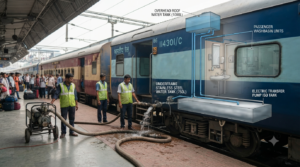
How Do Long-Distance Trains Carry Water for Passengers? Inside the Railway Water Supply System
Have you ever wondered how a long distance train travelling for 24, 36 or even 48 hours provides water to hundreds or thousands of passengers? Whether you are travelling in Sleeper Class, AC 3-Tier, AC 2-Tier or First AC, you will find water taps in the washrooms throughout your journey.
But where does all this water come from? Does a train carry enough water for its entire journey, or does it refill its water supply at railway stations?
The answer is fascinating. Long-distance trains have specially designed water storage tanks, pumps, pipelines and water distribution systems that ensure passengers can use water during their journey.
Let’s understand how this entire system works.
1. How Much Water Do Long-Distance Trains Carry?
Indian Railways trains carry thousands of litres of water to meet the daily requirements of passengers.
The water is mainly used for:
- Washing hands and faces.
- Using washbasins in toilets.
- Flushing toilets.
- Cleaning and other coach-related requirements.
The total water capacity depends on the type and design of the coach.
For example, Indian Railways’ technical documents show that some LHB sleeper coaches have a total water storage capacity of approximately 1,820 litres, while certain other configurations have a capacity of around 2,175 litres.
A train with 20–24 coaches can therefore require tens of thousands of litres of water.
However, the exact capacity varies according to the coach design and the number of tanks installed.
2. How Do Long-Distance Trains Refill Their Water Tanks
You might think that water is stored in large tanks on the roof of a train. However, modern railway coaches use a more sophisticated arrangement.
Water storage tanks are generally installed underneath the coach body or in designated spaces, depending on the coach design.
In some LHB coach configurations:
- Large stainless-steel tanks are installed underneath the coach.
- Smaller overhead tanks are installed near the toilets.
- Pumps transfer water from the main storage tanks to the smaller tanks.
- Pipelines distribute water to washbasins and other outlets.
The tanks are designed to store water safely while the train is moving.
3. How Does Water Reach the Washbasins and Toilets in Long Distance Train?
The water supply system works through a combination of storage tanks, pumps, pipelines and gravity.
Here is how the mechanism works:
Step 1: Water Storage
Fresh water is filled into the main storage tanks installed in the coach.
Understanding how long-distance trains carry water requires looking at their specially designed storage tanks. These tanks hold thousands of litres of water, which is distributed to different passenger facilities through an interconnected pipeline system.
Step 2: Water Pumping
In coach designs that use intermediate overhead tanks, electric pumps transfer water from the main storage tanks to these smaller tanks.
Another interesting part of how long-distance trains carry water is the pumping mechanism. Electric pumps help transfer water from the main storage tanks to designated overhead tanks, allowing water to reach passenger washbasins and other facilities.
Step 3: Water Distribution
Water travels through a network of pipelines installed inside the coach.
The Indian Railways Quick Watering System makes it easier to understand how long-distance trains carry water efficiently. High-capacity pumps, large pipelines and automated controls help railway staff refill coach water tanks in a shorter time.
Step 4: Gravity-Based Supply
In systems with overhead tanks, gravity helps water flow down towards washbasin taps and other outlets.
Step 5: Passenger Usage
Passengers can use the available water through taps and the designated toilet facilities.
The complete system is designed to maintain water availability during the train journey.
4. How Do Long-Distance Trains Refill Water?
A train does not always depend on the water filled at its starting station.
Long-distance trains stop at designated watering stations where railway staff refill the water tanks.
Special water pipelines and hydrant connections are available at these locations.
When a train arrives at a watering station:
- Railway staff connect water-filling hoses to the coach filling points.
- Water is supplied from the station’s water infrastructure.
- The coach storage tanks are refilled.
- Staff and monitoring arrangements help ensure adequate water availability before the train continues its journey.
This process is particularly important for trains travelling long distances.
5. What Is the Quick Watering System Used by Indian Railways?
One of the most interesting technologies used by Indian Railways is the Quick Watering System (QWS).
Previously, filling the water tanks of an entire train could take considerable time. Traditional arrangements used smaller water pipes and required longer stoppages.
To improve efficiency, Indian Railways introduced mechanised water-filling arrangements.
The system uses:
- High-capacity water pumps.
- Larger-diameter water pipelines.
- Automated valves.
- SCADA technology (Supervisory Control and Data Acquisition).
- Computerised water-flow monitoring and control.
According to the Comptroller and Auditor General of India’s 2025 railway audit report, the Quick Watering System can fill a 24-coach train in approximately five to six minutes under the specified system conditions.
This technology helps reduce water-filling time and unnecessary train delays.
6. How Does SCADA Technology Help Refill Train Water Tanks?
SCADA is an industrial automation technology used to monitor and control equipment remotely.
In railway water-filling systems, SCADA helps manage the water supply process.
Here is how it works:
- High-capacity pumps generate the required water pressure.
- Automated valves control the flow of water.
- The system allows operators to monitor and manage the water supply.
- Remote operation helps improve the efficiency of the filling process.
This means railway staff can manage the water-filling operation more efficiently instead of relying entirely on traditional manual arrangements.
7. Does Indian Railways Monitor Water Levels in Running Trains?
Yes. Indian Railways has also been introducing IoT-based water-level monitoring technology.
IoT stands for Internet of Things.
These systems use sensors to monitor water levels in coach tanks and help railway authorities identify coaches that may require additional water.
According to Indian Railways’ Annual Report and Accounts 2024–25, IoT-based water-level indicators had been installed in 1,314 coaches, covering 1,518 systems. Further installations were also sanctioned.
This technology can help railway staff identify low-water situations and plan refilling at suitable stations.
8. Is the Water Available in Train Washbasins Safe to Drink?
This is an important question.
The water supplied through coach washbasin taps is primarily intended for washing and toilet-related purposes. Passengers should not automatically assume that it is suitable for drinking.
For drinking water, passengers should use sealed packaged drinking water, such as Rail Neer, or approved drinking-water facilities at railway stations.
Indian Railways has separate arrangements and quality-monitoring protocols for drinking water supplied to passengers.
9. What Happens If a Train Runs Out of Water?
If a coach runs low on water during a journey, passengers may experience problems such as:
- Washbasin taps stopping or providing very little water.
- Difficulty using toilet facilities.
- Insufficient water for handwashing.
Railway staff can arrange water replenishment at designated stations wherever facilities are available.
Water-level monitoring technology can also help railway authorities identify coaches that need attention.
Conclusion
The next time you travel on a long-distance train, remember that the water flowing from the washbasin taps is supported by an entire engineering system.
From large storage tanks and electric pumps to pipelines, automated valves, SCADA technology and IoT-based monitoring, Indian Railways uses several technologies to maintain water availability throughout long journeys.
It is another example of how engineering and automation help manage the everyday needs of millions of railway passengers.
Now you know how long-distance trains carry water during extended journeys. From onboard storage tanks to automated refilling systems, railway engineering ensures that passengers have access to water for essential daily activities.
Did you know that modern Quick Watering Systems can refill a 24-coach train in approximately five to six minutes?
Share this interesting railway technology fact with your friends!
Frequently Asked Questions (FAQs)
Q1. How much water does an Indian Railways coach carry?
It depends on the coach type. Some LHB sleeper coach configurations have approximately 1,820 litres of water storage capacity, while others have different capacities.
Q2. How often is water refilled in long-distance trains?
Water is replenished at designated watering stations during the journey. The frequency depends on the route, train schedule, water consumption and coach configuration.
Q3. How does water reach train washbasins?
Water flows through pipelines from storage tanks. Depending on the coach design, pumps and gravity-based systems help distribute it.
Q4. What is the Quick Watering System?
It is a mechanised railway water-filling arrangement that uses high-capacity pumps, larger pipelines and automated controls to refill train coaches quickly.
Q5. Can passengers drink water from train washbasin taps?
Passengers should not assume that washbasin water is drinking water. Use approved packaged drinking water or designated potable-water facilities.